xDEVS Chain
Enclave public testnet is livechain id 717171

The chain that has your back.

xDEVS Chain is an EVM-equivalent Layer 1 that protects people at the protocol level. Passkeys instead of seed phrases, a vault that holds large transfers for review, approvals that expire and names that can’t be faked.

  1. #000,0000 txs0x0000
  2. #000,0000 txs0x0000
  3. #000,0000 txs0x0000
  4. #000,0000 txs0x0000
  5. #000,0000 txs0x0000
  6. #000,0000 txs0x0000

Connecting to the Enclave testnet…

Why it exists

Most chains compete on speed and fees. People lose money another way: a lost seed phrase, a drained wallet, an approval they forgot, an address that looks almost right. xDEVS Chain moves the protection into the chain.

The safety layer

Protection, built into the chain. Opt-in, and no admin key.

01 Passkey accounts

No seed phrase. Not one word to write down.

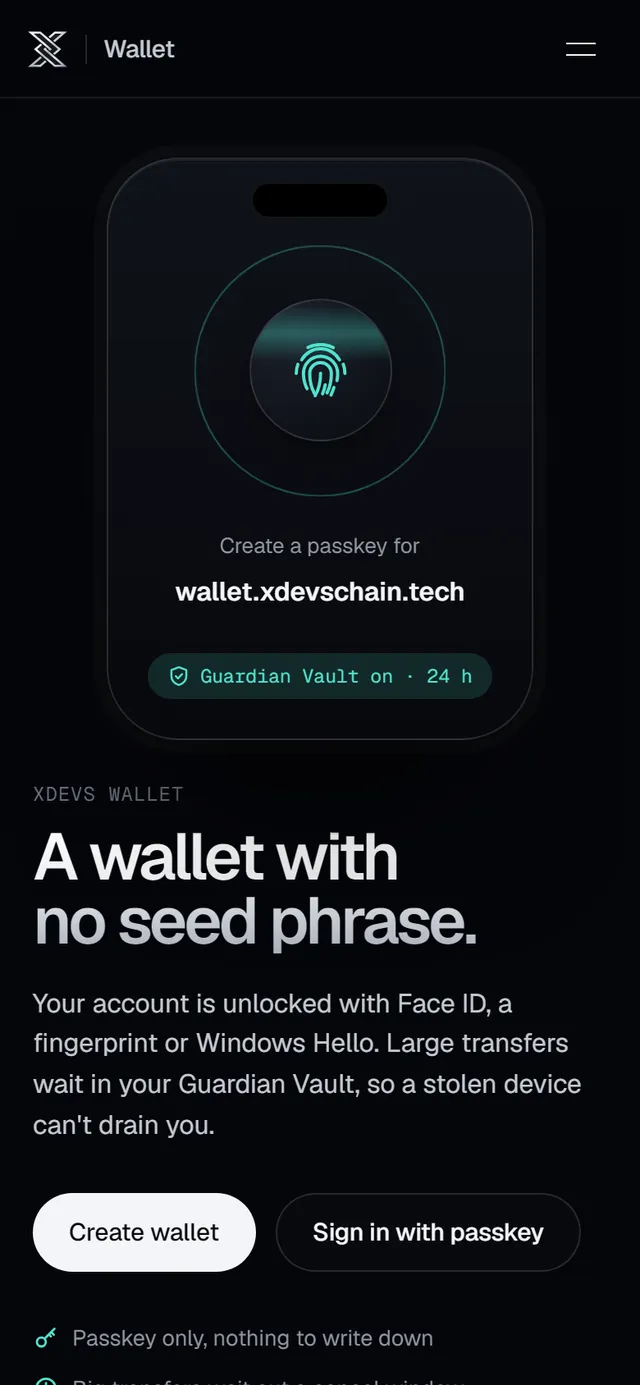
Your account is a smart contract you unlock with Face ID, a fingerprint or Windows Hello. The key stays on your device, and activation is sponsored, so a new account starts without buying coins first.

  • Passkey signatures verified on-chain (P-256)
  • Recovery through guardians you choose
  • Runs in the browser, nothing to install
How it works

The xDEVS wallet start screen: create a passkey for wallet.xdevschain.tech

02 Guardian Vault

A stolen phone can’t empty your account.

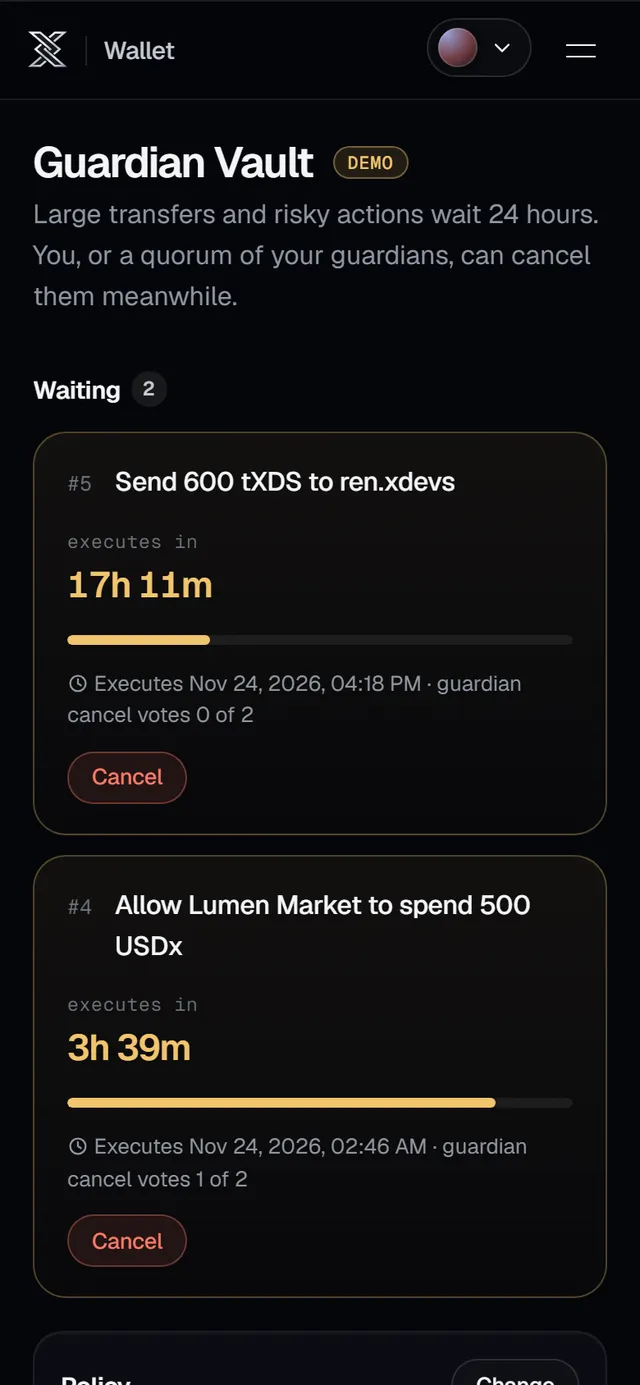
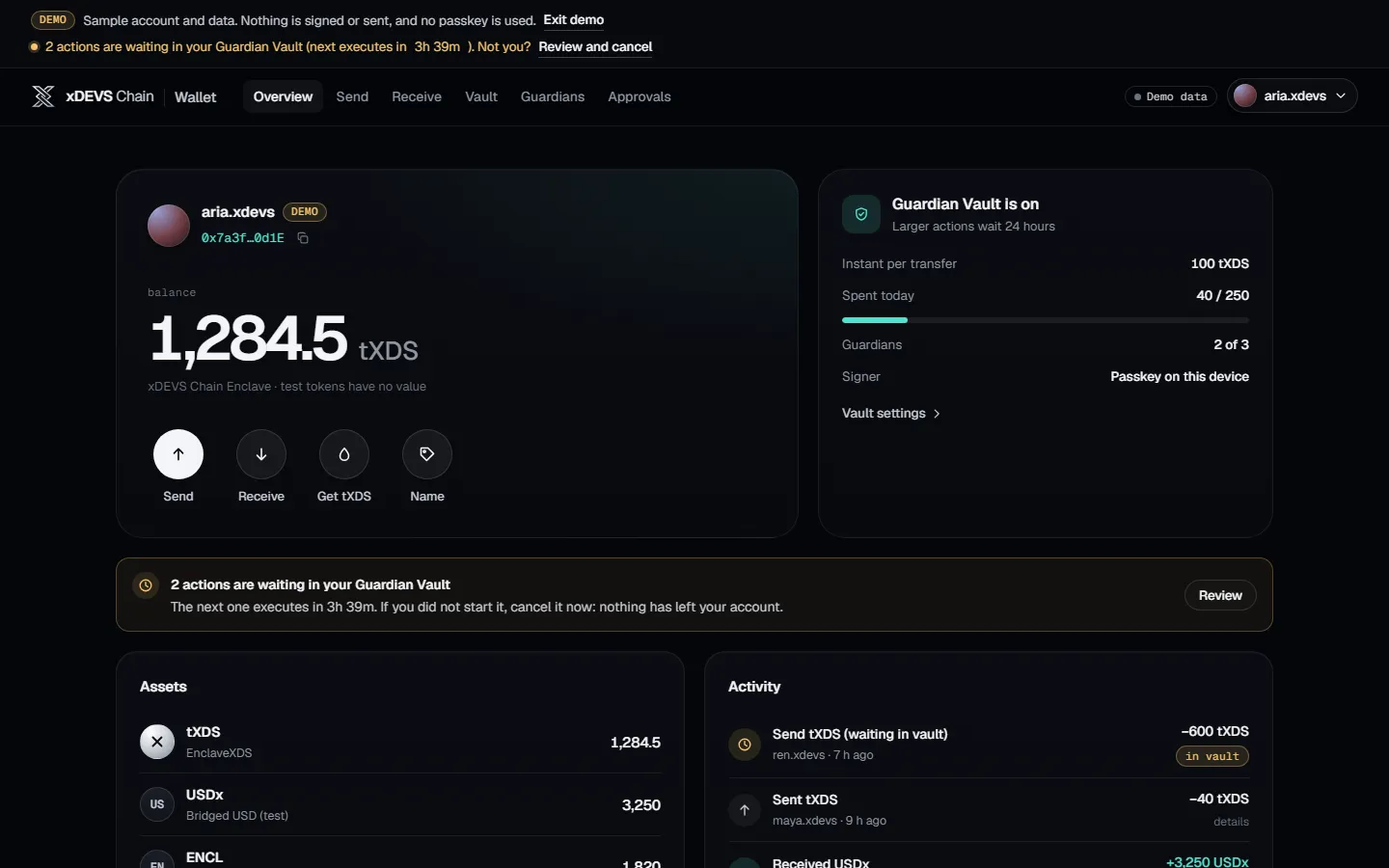
Everyday payments stay instant. Anything above your limit, every token approval and every call to an unknown contract waits out a delay, 24 hours by default. You or your guardians can cancel it in that window.

  • You set the instant limit per transfer and per day
  • Turning protection off waits out the same delay
  • Never reverses a finalized transaction

How it works

Guardian Vault in the wallet demo: two queued actions with countdowns and cancel buttons

03 Guardians, freeze and recovery

Lose your device. Keep your account.

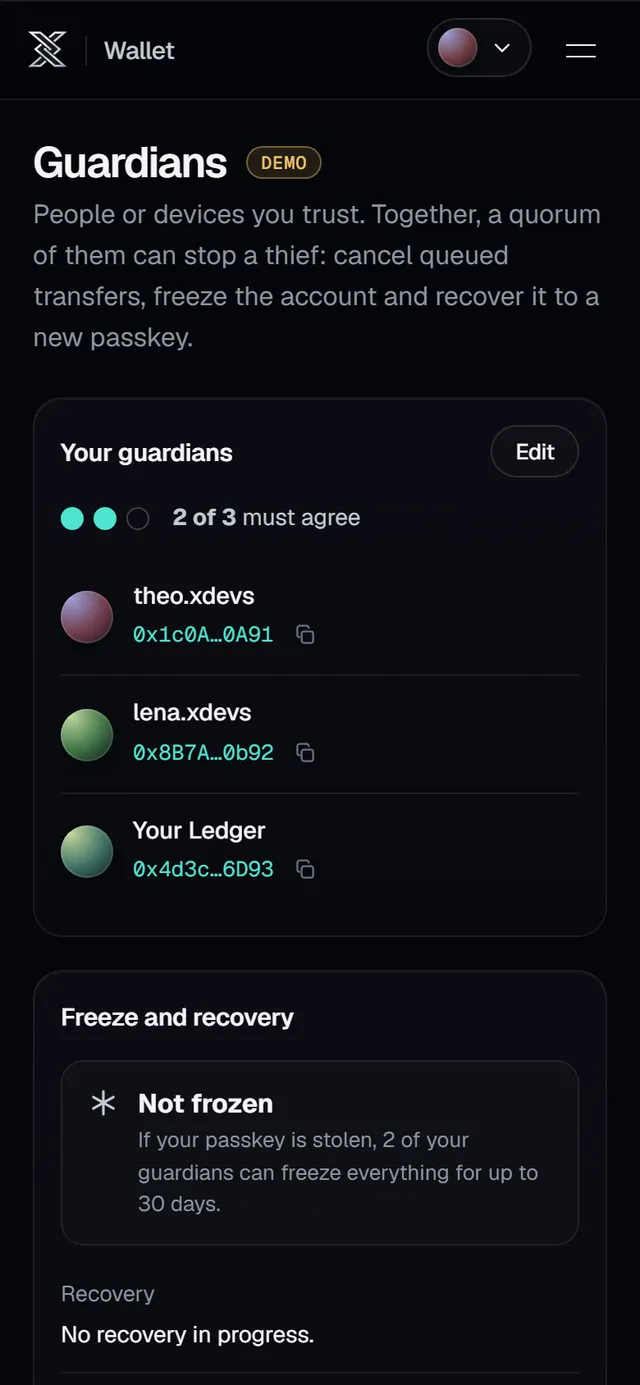
Pick friends, a second device or a hardware key as guardians. Together they can cancel queued transfers, freeze the account and recover it to a new passkey. No company, validator or vote can do that for them.

  • A quorum you choose, for example 2 of 3
  • Freeze ends an owner-versus-thief stalemate
  • No admin key over anyone’s funds

How it works

Guardians screen in the wallet demo: three guardians, two of three must agree, freeze and recovery status

04 Safety checks

See what you’re signing before you sign it.

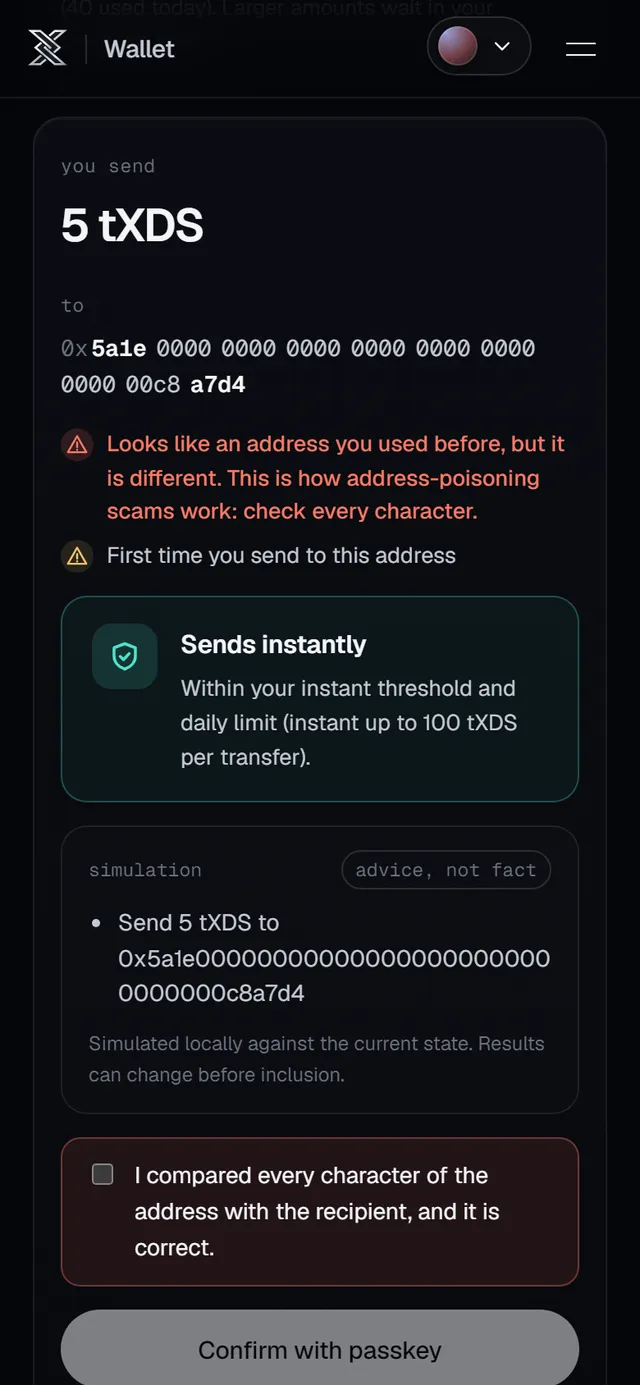
The network simulates the transaction and checks the recipient before you confirm. You see what moves, which approvals it sets, and a plain warning when an address only looks like one you paid before.

  • Simulation: asset changes and the vault outcome
  • Recipient checks: first-time and look-alike addresses
  • Shown as advice, never as a promise of safety

How it works

Send review in the wallet: a red warning that the address looks like one used before but is different

05 Expiring approvals

Approvals that end on their own.

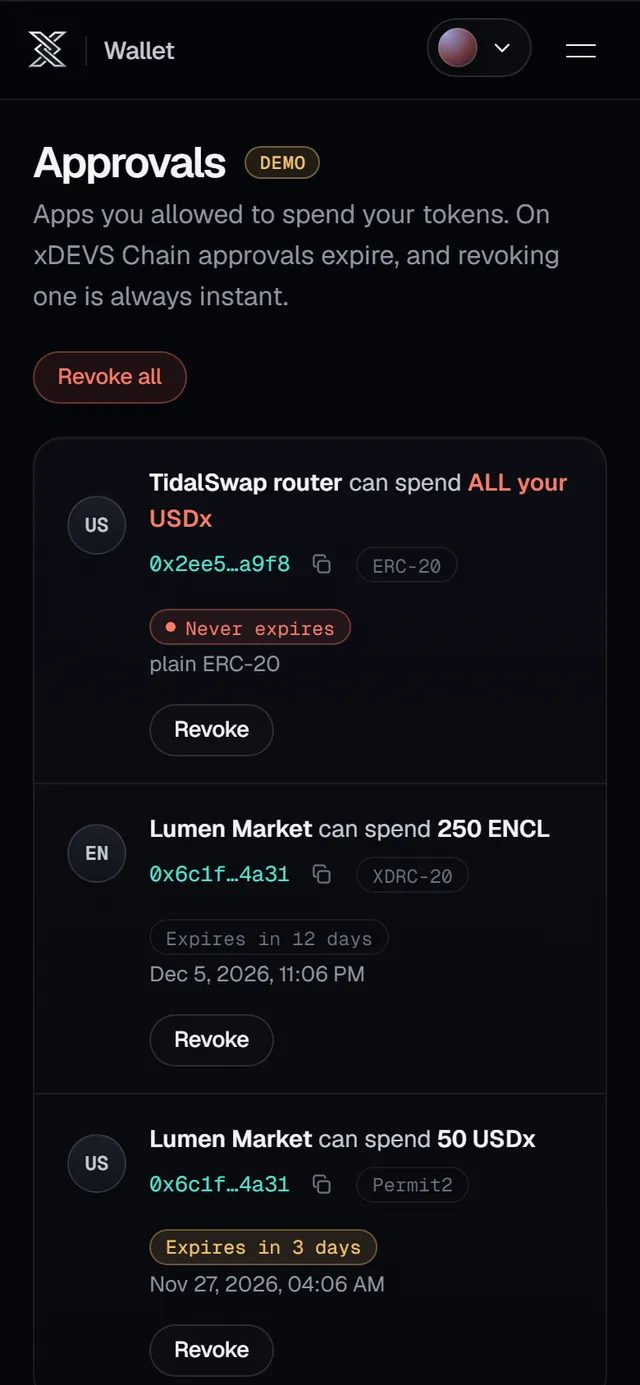
A forgotten unlimited approval can be drained years later. XDRC-20 tokens and the Permit2Expiring contract put an expiry on every allowance, and the wallet shows them all with a one-tap revoke.

  • Every Permit2Expiring allowance has an expiry
  • Unlimited and never-expiring approvals are flagged
  • Revoke one, or revoke all

How it works

Approvals screen in the wallet demo: an unlimited approval flagged as never expiring, others expiring in days

06 .xdevs names

Names that refuse to be faked.

XNS turns a long address into a name like aria.xdevs and rejects names that look like one that already exists. While alice.xdevs exists, nobody can register a1ice.xdevs.

  • Only a to z, 0 to 9 and hyphens: no look-alike Unicode
  • 0, 1, rn, vv and cl count as o, l, m, w and d
  • The first registrant wins

How it works

07 One-block finality

Final in one block. About two seconds.

Malachite BFT consensus commits each block once validators holding more than two thirds of the voting power have signed it. A committed block is never reorganised, so a payment is done the moment it lands.

  • 2-second blocks on Enclave
  • No reorgs after commit
  • Commit certificates readable over RPC

How it works

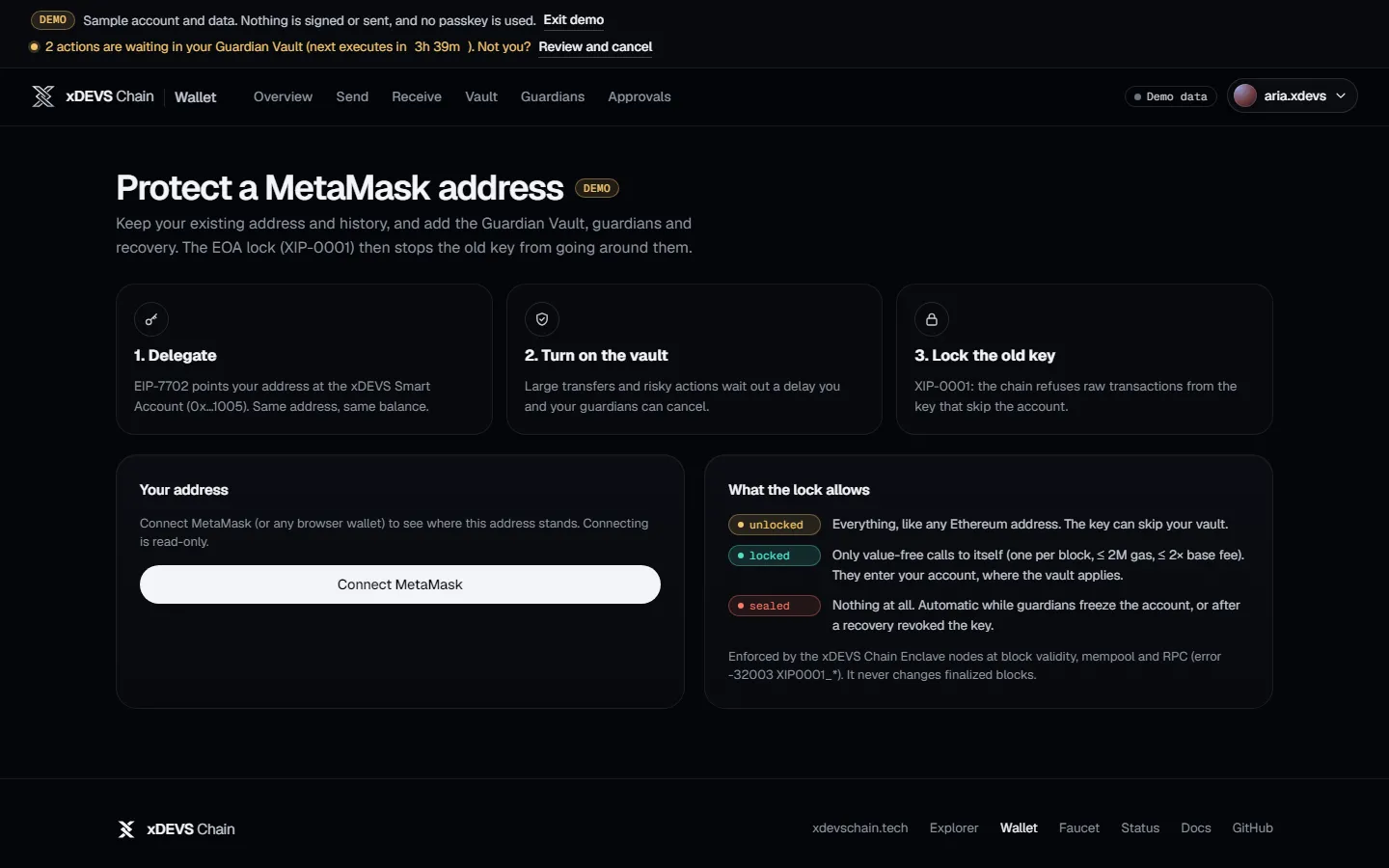
The EOA lock page in the wallet demo: delegate, turn on the vault, lock the old key

Already on MetaMask

Keep your address. Lock the old key.

Point your existing address at the xDEVS smart account with one EIP-7702 transaction and keep its history and balance. The EOA lock (XIP-0001) is a node rule: once it’s on, the old private key can’t go around the vault.

How the EOA lock works

For developers

If it runs on Ethereum, it runs here.

xDEVS Chain is EVM-equivalent: revm under Osaka rules and the standard JSON-RPC. Solidity, MetaMask, Foundry, Hardhat, viem and ethers work without a fork or a plugin.

  • Chain id 717171, 2-second blocks, final in one
  • Safety methods next to eth_: simulate, check a recipient, list approvals
  • Passkey smart accounts through an ERC-4337 bundler
# Enclave looks like any EVM chain to your toolsexport RPC=https://rpc.xdevschain.techcast chain-id --rpc-url $RPC        # 717171cast block-number --rpc-url $RPC    # grows every 2 s # Deploy a contractforge init counter && cd counterforge create src/Counter.sol:Counter --rpc-url $RPC --chain 717171 --private-key $PK --broadcastcast send $COUNTER "increment()" --rpc-url $RPC --chain 717171 --private-key $PK
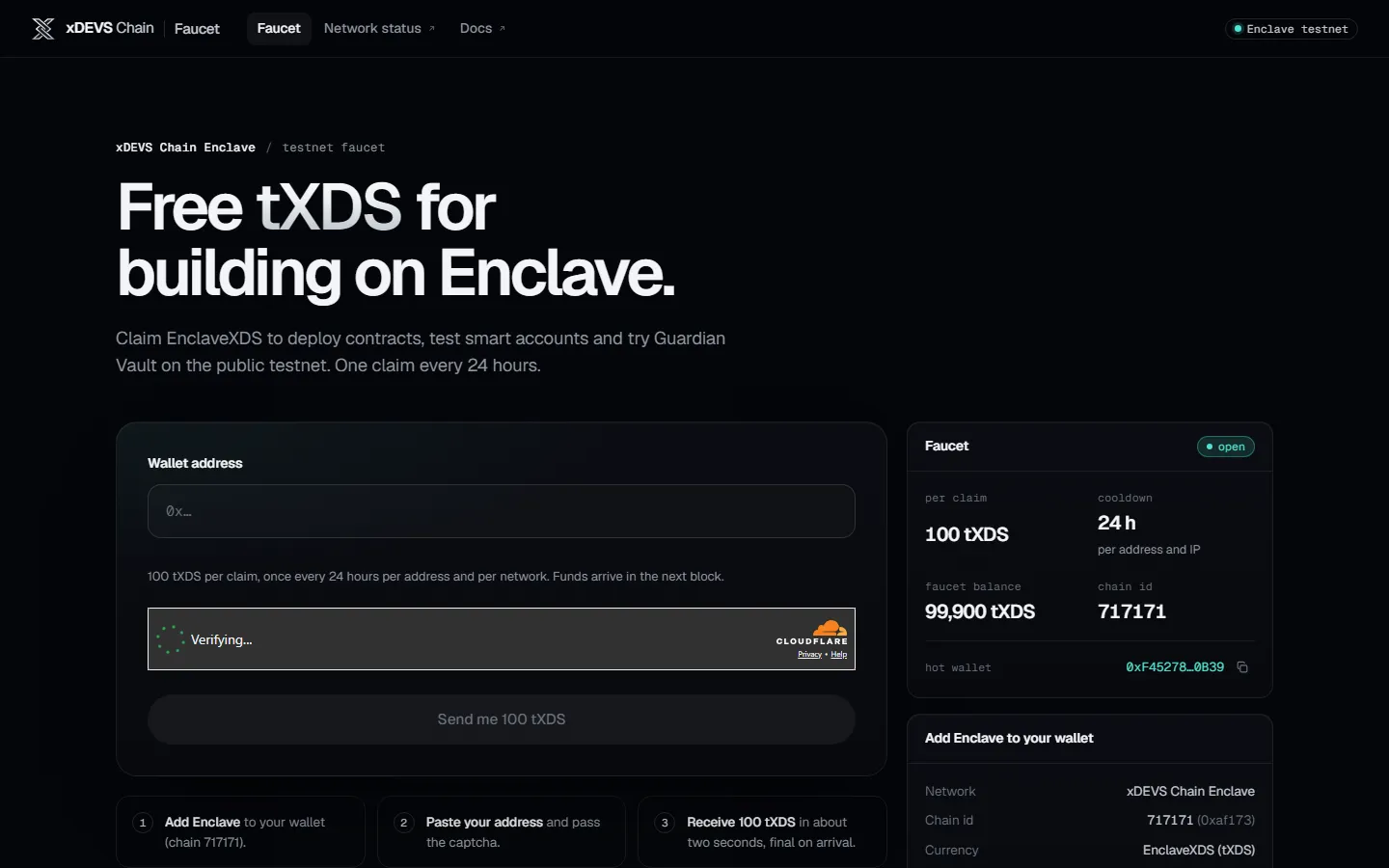
Unchanged Foundry. Get tXDS from the faucet first.

Right now

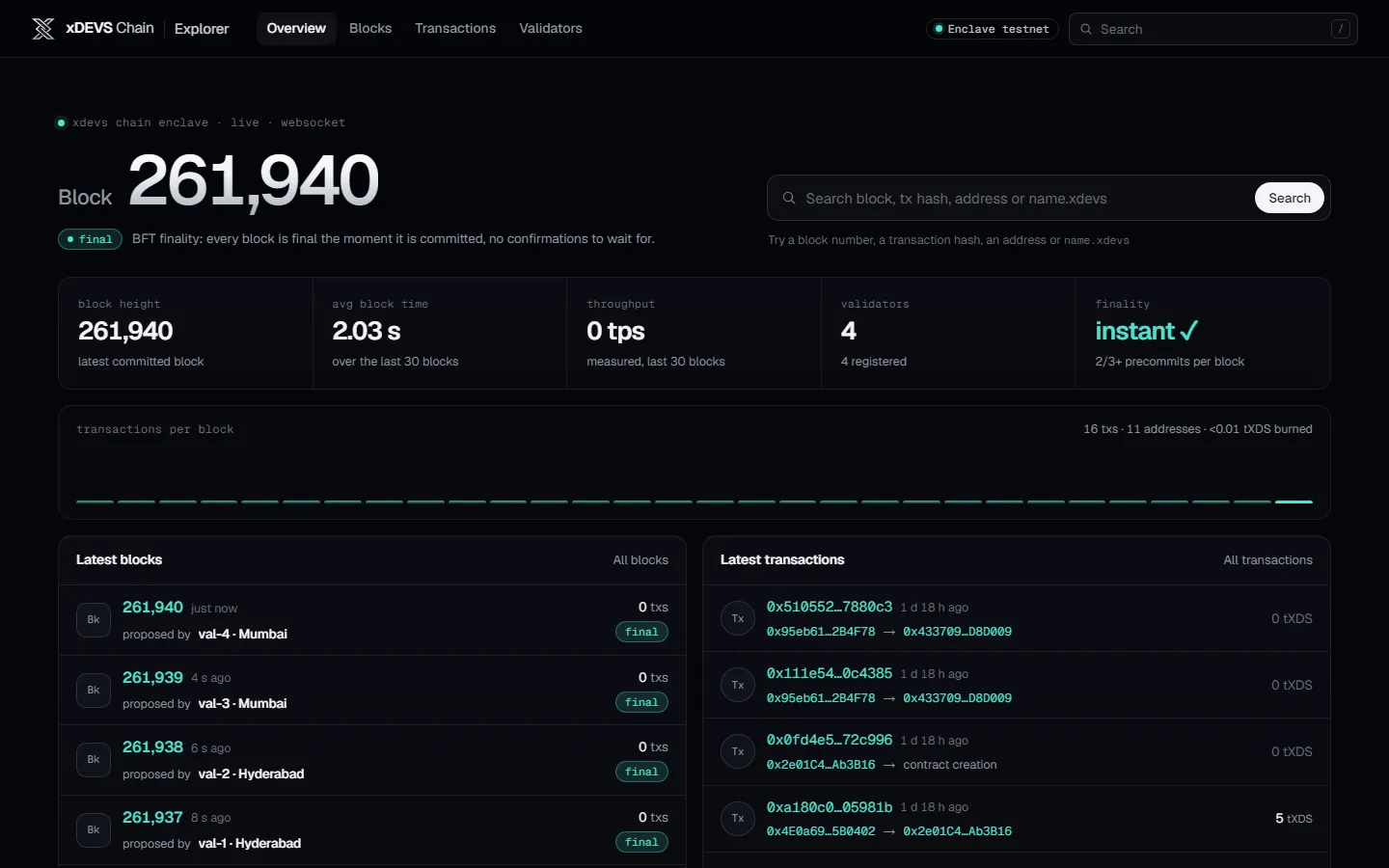
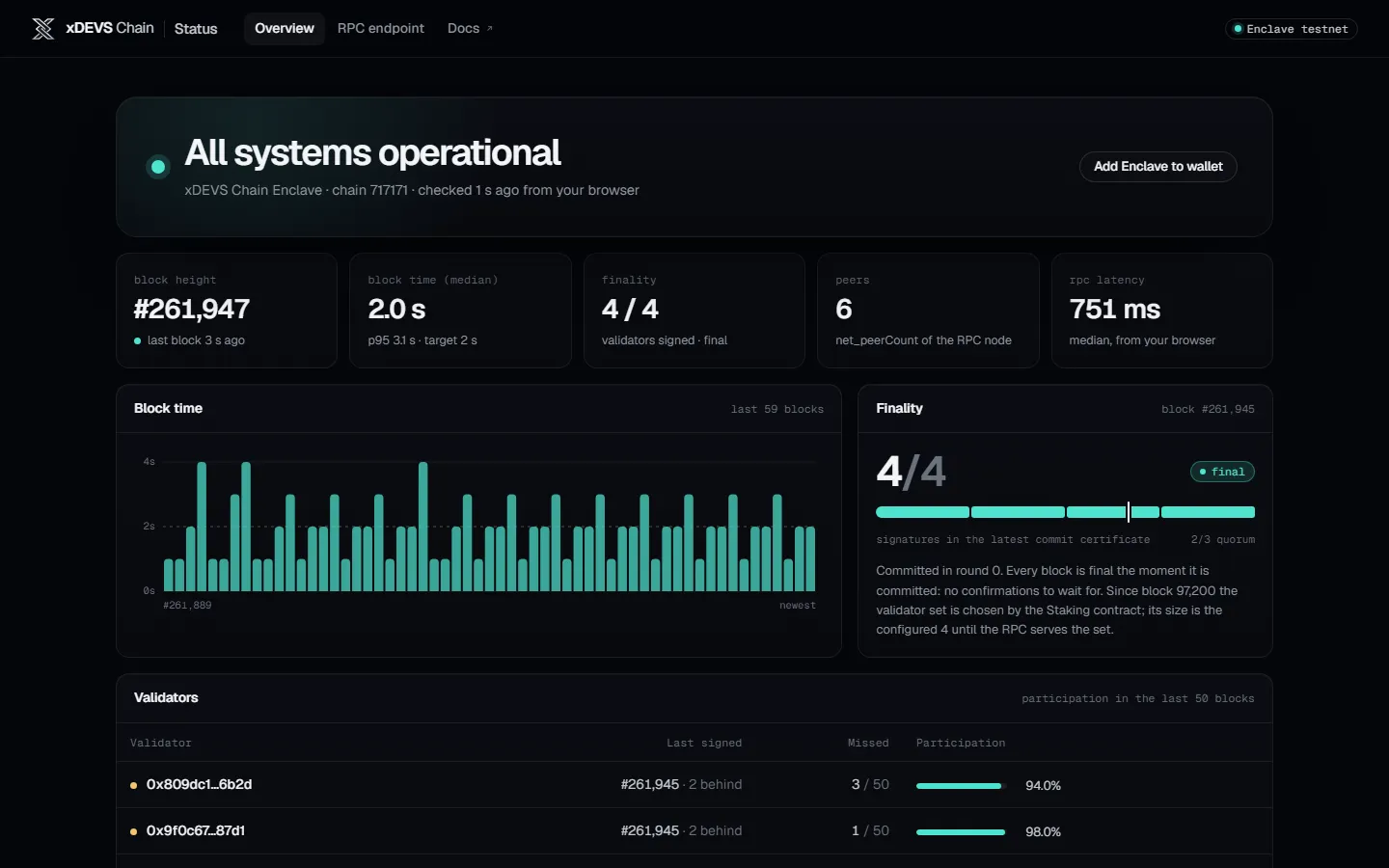
Enclave is running. These numbers are live.

ConnectingEnclave public testnet

Full network status
Latest block
—

Every one of them final.

Block time
—s

Average of the last 60 blocks.

Finality
1block

BFT, no reorgs after commit.

Validators
4

Operated by the project.

Chain id
717171

tXDS has no value.

Read directly from rpc.xdevschain.tech by your browser.Hyderabad and Mumbai · Oracle Cloud

Under the hood

A careful Layer 1, not a fast-and-loose one.

Every feature below is live on Enclave. Where something is built but not switched on, we say so.

BFT consensus, one-block finality

Malachite (Tendermint-style) with execute-before-vote and stored commit certificates. One of four validators down: the chain keeps going.

Block-STM parallel execution

Transactions run in parallel and give the same result as running them one by one, checked by differential tests. Live on every Enclave validator.

Local fee markets

A contract that floods a block gets its own base fee. Everyone else keeps paying the normal fee. Live since block 97,200.

Staking-driven validator set

Epochs, block rewards, and slashing for downtime and double-signing, read from the Staking contract since block 97,200.

Proposer rotation

Block proposals rotate across the validator set, live on Enclave since block 225,000.

Rust, revm and alloy

An Ethereum-exact node written in Rust: same hashes, receipts and state roots, Osaka rules, EIP-1559 and EIP-7702.

Encrypted mempool Built, switched off

Transactions stay encrypted until their order is final, so bots can’t sandwich them. A test shows it stopping a sandwich attack. It turns on after a distributed key setup and an external review.

Light-client bridge Prototype

No multisig bridges. A two-way light-client bridge with Ethereum Sepolia is built and tested on real data. It is not deployed and waits for an external audit.

Measured, not promised

A 5-hour soak test of a 4-validator network under load.

5h
Soak test under load
4
Validators, BFT consensus
360,000
Transactions
0
Forks

Roadmap

Built in phases. Shipped in the open.

Phases 0 to 5 are built and most of it runs on Enclave. Independent validators, audits and mainnet come next. We don’t promise dates.

The full roadmap

  1. Phase 0: Foundations

    Done

    Repository, Apache-2.0 license, contribution and security policies, architecture decision records.

    • ADRs 0001 to 0008
    • Security policy and private reporting
  2. Phase 1: A single node that MetaMask understands

    Done

    Ethereum-exact blocks, transactions and state roots on revm, with an Ethereum JSON-RPC.

    • Legacy, EIP-1559 and EIP-7702 transactions
    • MetaMask sends tXDS; forge and cast work
  3. Phase 2: A multi-validator BFT network

    Essentially done

    Malachite consensus with execute-before-vote, commit certificates, block sync and transaction gossip.

    • One of four validators down: the chain keeps going
    • Two down: it halts safely and resumes, no forks
  4. Phase 3: Proof of Stake and the public testnet

    Live on Enclave

    Enclave went live on 17 Nov 2026. The validator set has been driven by the Staking contract since block 97,200.

    • Public RPC, explorer, wallet, faucet, bundler, status page
    • Block rewards, downtime and double-sign slashing
    • Proposer rotation since block 225,000
  5. Phase 4: The user-safety layer

    Live on Enclave

    Passkey accounts, Guardian Vault, freeze and recovery, expiring approvals, .xdevs names, the EOA lock and the safety RPCs.

    • Reference wallet at wallet.xdevschain.tech
    • Simulation and recipient checks served by the RPC
    • Next: an alert bot for vault events
  6. Phase 5: Performance and MEV protection

    Built

    Block-STM parallel execution and local fee markets run on Enclave. The encrypted mempool is built and switched off.

    • Parallel execution on every Enclave validator
    • Per-contract fees since block 97,200
    • Encrypted mempool waits for a distributed key setup and review
  7. Phase 6: Public testnet and community

    Next

    A long-lived testnet with independent validators, snapshot sync, a bug bounty and real governance on testnet.

    • Independent community validators
    • Incentivised testnet with points, not tokens
    • Hackathons and a bug bounty
  8. Phase 7: Interop and mainnet preparation

    Prototype built

    Light-client bridges only, never multisig bridges. Then independent audits and a genesis ceremony for mainnet.

    • Sepolia light-client bridge: prototype, not deployed
    • Independent security audits
    • Mainnet: coming next, no date

Start on Enclave.

Create a passkey account, get free test coins and deploy your first contract. It takes a few minutes and costs nothing.

Enclave is a test network. tXDS has no value and never converts to mainnet XDS.